Build the clarity of your business.
A clear business isn’t one big document — it’s a collection of small, sharp pieces, assembled. A vision statement. A market analysis. An ideal customer profile. A one-page plan. The Resolute Method gives you 23 of them, free, and shows you how they lock together into a business plan and the operating plan that runs it. Build one this afternoon — or assemble the whole picture.
First, see where you stand.
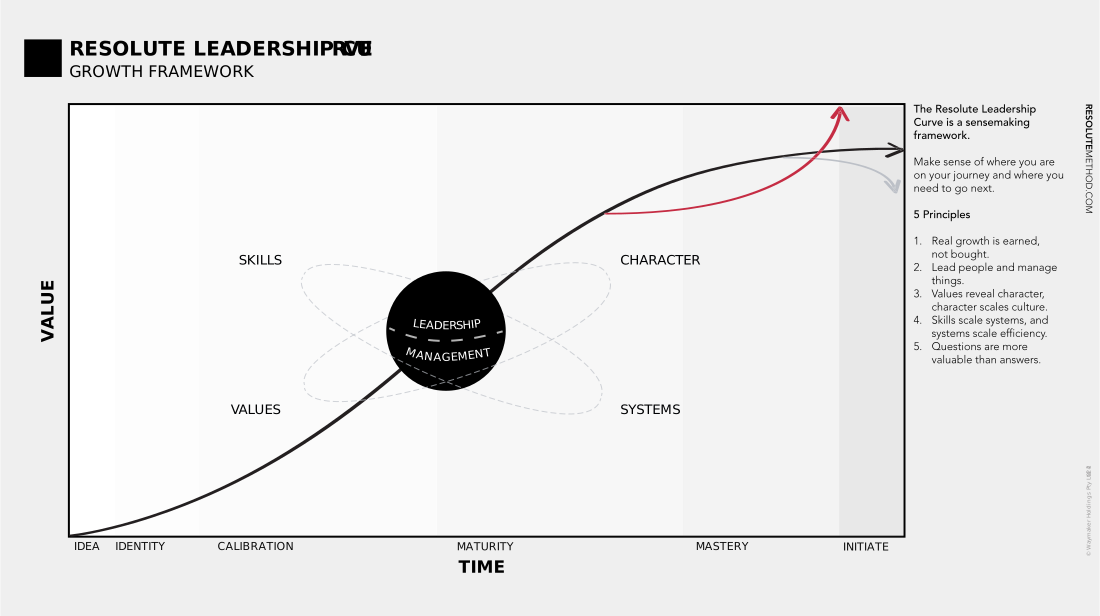
Resolute is a thinking system, not an operating system. It begins with one sensemaking framework — the Resolute Leadership Curve — the meta-framework everything else hangs off. It shows you where your organisation actually sits on the climb from chaos to mastery, and what the next stage will demand. Make sense of that first; then build.
Your Business Plan.
The leadership plan — how you climb the curve. Seven sections, one per leadership question: vision, market, strategy, business model, customer experience, employee experience, and the goal — the one, two, or three things that shift the needle this year.
Each section is worked two ways. A Canvas opens the thinking — divergent: argue it out, fill the squares, leave some blank. A Clarity Statement closes it — convergent: compress the answer to one line you can put on a wall. A canvas without a clarity statement never lands; a clarity statement without a canvas is a slogan.
The assembled documentBuild a business plan
The 7 Questions Business Plan
The document the seven sections assemble into — your organisation’s definitive “who we are” and where it’s going. The long-term picture with the detail; the reference behind every campaign and every serious decision.
See its structure +Close −
What makes it more than seven canvases
A business plan isn’t the canvases stapled together. The template adds the parts that make them cohere — and turn a set of answers into a document your team can run the year on.
- Executive summary
- Performance context, current position, and the two or three priorities that matter most right now.
- The seven sections
- Each leadership question worked as a canvas and closed with a clarity statement — vision through to the goal.
- Cross-question consistency check
- Does vision align to strategy, strategy to the business model, culture to customer experience? Where it doesn't, you find out here — not in the market.
- Implementation roadmap
- Year one, years two–three, and the long-term trajectory toward the vision.
- Strategic scorecard
- The handful of metrics that tell you the plan is actually working.
- Risk summary
- The risks that could derail it, each with a mitigation and an owner.
- Supporting plans
- Where the detail hangs off — marketing, sales & service; budget & cash flow; the company calendar.
Its companion — the 5 Questions Management Plan (your Operating Plan) — is the quick annual execution plan derived from it.
Vision
VisionBuild a vision statement
The Vision & Purpose Canvas
Put words to the world you're trying to build — before you ask anyone to help you build it.
Quick overview +Close −
What it gives you
Works the first leadership question: why this organisation exists and where it's headed. The canvas opens the field; its clarity statement compresses the answer into a single sentence you can put on a wall and a team can act on twice the same way. Vision that can't be said in a sentence isn't shared — it's just yours.
Reach for it whenWhen people are busy but no one can say what it all adds up to.
Market
MarketBuild a market analysis
The Market Canvas
Get honest about the market you're really in — not the one on the pitch deck.
Quick overview +Close −
What it gives you
Works the second leadership question at the market level: size, segments, trends, and where the real opportunity sits. Its clarity statement names the market you're playing in plainly, because a market defined too broadly is a market you can't win.
Reach for it whenWhen 'our market is everyone' is starting to sound like a problem.
MarketBuild an ideal customer profile
The Ideal Customer Canvas
Describe the customer you're built for so precisely you'd recognise them in a room.
Quick overview +Close −
What it gives you
Profiles the customer worth building the whole business around — what they want, what they fear, what they're already doing instead. Its clarity statement compresses it to a sentence, because if everyone is your customer, no one is.
Reach for it whenWhen marketing speaks to everyone and lands with no one.
Strategy
StrategyBuild a strategy & positioning
The Strategy & Positioning Canvas
Decide what you're actually betting on — and what you're choosing not to do.
Quick overview +Close −
What it gives you
Turns the third leadership question into a position you can defend: where you play, how you win, and the trade-offs that make it real. Its clarity statement forces the strategy into one shape, because a strategy that keeps everything open isn't a strategy — it's a wish list.
Reach for it whenWhen the plan is to do a bit of everything and hope.
Business model
Business modelBuild a business model
The Business Model Canvas
See the whole machine of how you create, deliver, and capture value on one page.
Quick overview +Close −
What it gives you
How you create, deliver, and capture value, on one page. Three canvases serve different businesses — the Business Model Canvas (the familiar nine blocks), the Lean Canvas (built for a new venture), and Reinvent Your Business Model (to challenge an existing one). Pick the one that fits; all three are in the kit.
Reach for it whenWhen the business has grown complex and no one holds the whole picture.
Business modelBuild a business-model statement
The Business Model Clarity Statement
Sum up how the business actually works in one line the whole team can repeat.
Quick overview +Close −
What it gives you
Closes the business-model question: a single structured statement of how you make money and why it holds together. The test of understanding your own model is whether you can say it simply.
Reach for it whenWhen two leaders describe how the business makes money and don't match.
Business modelBuild a value proposition
The Value Proposition Clarity Statement
Say why a customer should choose you in one sentence that's actually true.
Quick overview +Close −
What it gives you
Compresses everything the business model work produced into a single claim of value — for whom, what, and why you. If it takes a paragraph, you haven't found it yet.
Reach for it whenWhen you can't explain what you do before the other person's attention runs out.
Customer experience
Customer experienceBuild a customer journey map
The CX: Journey Canvas
Walk the path your customer actually takes — including the parts that quietly cost you them.
Quick overview +Close −
What it gives you
Maps the customer experience end to end — the steps, the feelings, the moments that make or break the relationship. Its clarity statement names the experience you intend to deliver, so the journey is designed rather than accidental.
Reach for it whenWhen customers leave and you're not sure where you lost them.
Customer experienceBuild a customer promise
The CX: Promise Canvas
Decide what you promise every customer — and what it takes to keep it.
Quick overview +Close −
What it gives you
Defines the experience promise at the heart of the brand and the standards that make it real at every touchpoint. A promise you can't consistently keep isn't a promise — it's a future complaint.
Reach for it whenWhen the experience depends on who happens to pick up the phone.
Employee experience
Employee experienceBuild an employee journey map
The EX: Journey Canvas
Map the employee journey the way you'd map a customer's — because it shapes everything they touch.
Quick overview +Close −
What it gives you
Traces the experience of working in your organisation from first contact to farewell — the moments that build commitment and the ones that erode it. Its clarity statement names the experience you intend to create. Your customers will never love a company the employees don't.
Reach for it whenWhen good people keep leaving and exit interviews all rhyme.
Employee experienceBuild your company values
EX: Values
Find the values you actually live — not the ones painted on the wall.
Quick overview +Close −
What it gives you
Surfaces the real operating values of the organisation and tests them against behaviour. Values reveal character, and character scales culture — so the values you tolerate matter more than the ones you publish.
Reach for it whenWhen the stated values and the lived culture have stopped matching.
Employee experienceBuild a culture code
EX: Values, Principles & Behaviours Canvas
Turn values into the specific behaviours people can actually be held to.
Quick overview +Close −
What it gives you
Translates abstract values into principles and the observable behaviours that prove them — what 'integrity' or 'ownership' looks like on a Tuesday. Culture is built from behaviours you reward and tolerate, not posters you hang.
Reach for it whenWhen everyone agrees on the values and disagrees on what they mean.
Employee experienceBuild a culture plan
EX: Culture Shapers Canvas
Name the forces actually shaping your culture — most of them aren't on the values poster.
Quick overview +Close −
What it gives you
Identifies the real levers that form culture — who gets promoted, what gets celebrated, what gets ignored — so you can shape it deliberately instead of by accident. Culture is happening whether or not you're designing it.
Reach for it whenWhen the culture is drifting and you want to know what's steering it.
Employee experienceBuild an employee persona
EX: Employee Persona Canvas
Understand the people you're leading as clearly as the customers you're selling to.
Quick overview +Close −
What it gives you
Profiles the kinds of people who do the work — what motivates them, what they need, what makes them stay. You design the customer experience around personas; this asks you to do the same for the people delivering it.
Reach for it whenWhen engagement initiatives keep missing because they treat everyone the same.
Employee experienceBuild a role description
The Role Description Canvas
Define a role by the outcomes it owns, not the tasks it does.
Quick overview +Close −
What it gives you
Takes one role and makes it unambiguous: the outcomes it's accountable for, the decisions it can make, and how you'll know it's working. A job title is not a job; this is the difference between hiring activity and hiring results.
Reach for it whenWhen you're about to hire, promote, or quietly resent someone for not doing a job you never defined.
Employee experienceBuild an employee value proposition
EX: Value Proposition Clarity Statement
Say why a great person should work here — and keep working here.
Quick overview +Close −
What it gives you
Articulates the employee value proposition in a single claim: what people give, what they get, and why it's worth it. The mirror of the customer value proposition — and just as decisive for who you attract.
Reach for it whenWhen you're competing for talent and 'good culture' is all you've got to say.
Employee experienceBuild an employee promise
The EX: Promise Canvas
Make the promise to your people explicit — and worth keeping.
Quick overview +Close −
What it gives you
Defines the experience promise to employees and the standards that deliver it across the journey. The companion to the customer promise: keep one and break the other, and people feel the gap immediately.
Reach for it whenWhen you ask a lot of your team and haven't named what they get in return.
Goals
GoalsBuild your strategic priorities
The Strategic Goals Canvas
Name the one, two, or three things that will actually move the business this year.
Quick overview +Close −
What it gives you
Works the seventh leadership question: of everything you could do, which few strategic priorities shift the needle? It turns the whole business plan into a short list of needle-movers, each with an owner — so the strategy becomes a year, not a wish.
Reach for it whenWhen the plan has a hundred good ideas and no one can say which three matter most.
Assembled → a strategy your team can repeat back to you.
Unlock all the templates — free →Your Operating Plan.
The management plan — how you execute, this year. Five sections, one per management question: plan, roles, goals, meetings, and data. Same two modes: a Canvas to open it, a Clarity Statement to land it.
ManagementBuild a one-page plan
The Plan Canvas
Turn a year of good intentions into one page your team can run on Monday.
Quick overview +Close −
What it gives you
Works the first management question: what's the plan? It pulls the strategy down into priorities, owners, and the few things that actually matter this period — on a single page, because a plan no one can hold in their head doesn't get executed.
Reach for it whenWhen planning produced a deck nobody has opened since.
ManagementBuild an accountability chart
The Role Canvas
Map who owns what — so the gaps and the overlaps stop hiding.
Quick overview +Close −
What it gives you
Works the roles question at the organisation level: the functions that have to exist for the business to run, and who actually holds each one. It surfaces the work that's falling between chairs and the work three people think they own. Org charts show reporting lines; this shows accountability.
Reach for it whenWhen 'I thought you had it' is becoming a pattern.
ManagementBuild your goals
The Goal Canvas
Set goals people can actually steer by — not numbers they find out about at quarter's end.
Quick overview +Close −
What it gives you
Works the goals question: the few measurable outcomes that define winning this period, with the leading indicators that tell you early. It connects the plan to something you can track weekly, so course-correction happens while there's still road left.
Reach for it whenWhen you only learn you missed the target once it's too late to do anything.
ManagementBuild an operating rhythm
The Meeting Canvas (Operating Rhythm)
Design the heartbeat of the business — the meetings that move work, not the ones that bury it.
Quick overview +Close −
What it gives you
Works the meetings question: the cadence of conversations a team needs to stay aligned — daily, weekly, monthly, quarterly — each with a clear job. Done well it replaces the swarm of ad-hoc meetings with a rhythm; done badly, meetings are where time goes to die.
Reach for it whenWhen the calendar is full and alignment is still missing.
ManagementBuild a data scorecard
The Data Canvas
Pick the handful of numbers that actually tell you how the business is doing.
Quick overview +Close −
What it gives you
Works the data question: the few metrics that reveal the health of the organisation, who watches each one, and how often. Most teams drown in dashboards and starve for insight — this is how you find the signals worth steering by.
Reach for it whenWhen you have endless reports and still can't say if you're winning.
Assembled → a one-page plan you run on Monday.
Unlock all the templates — free →Sensemaking frameworks, not templates.
Resolute is a thinking system, not an operating system. These are the frameworks you think with — you don’t fill them in. The Resolute Leadership Curve is the meta-framework the rest hang off: the 7 Questions are the leadership plan to climb it; the 5 Questions are the management plan to execute each year. They show you where you stand and what to build next.
Sensemaking frameworkThe Resolute Leadership Curve
See where your organisation actually sits on the climb from chaos to mastery — and what the next stage will demand of you.
Quick overview +Close −
The map the whole method hangs off. It plots the six stages of growth against the work each one asks of a leader, so you can stop leading the company you used to run and start leading the one you actually have. Most strategic mistakes are really a leader applying stage-three habits to a stage-five problem — the Curve is how you catch that before it costs you.
See the thinking →Sensemaking frameworkThe Stages of Growth
Name the stage you're in — and the predictable wall waiting at the edge of it.
Quick overview +Close −
A closer look at the six stages beneath the Curve: what each one feels like from the inside, what breaks it, and what has to be built before you can leave it. Real growth is earned stage by stage, not bought — skip the work of one and it collects interest in the next.
See the thinking →Sensemaking frameworkGrowth Tension: Leadership vs Management
Tell leading and managing apart — and stop spending your best energy on the wrong one.
Quick overview +Close −
Leadership creates change; management executes the present. They are different jobs that pull in different directions, and the tension between them never resolves — you learn to live inside it. This frame shows you which mode a situation actually needs, so you stop managing things that need leading and leading things that just need to get done.
See the thinking →Sensemaking frameworkThe 7 Questions of Leadership
The seven questions that decide where the organisation is going — and whether anyone agrees.
Quick overview +Close −
The leadership half of the 12 Questions: vision, market, ideal customer, strategy, business model, customer experience, employee experience. Answer them and you have a strategy your team can actually repeat back to you. Leave them fuzzy and every plan downstream inherits the fog.
See the thinking →Sensemaking frameworkThe Transformation Iceberg
See the part of change that sinks organisations — the bit below the waterline.
Quick overview +Close −
A model for what's visible in a transformation (events, behaviours) versus what's hidden and load-bearing (structures, mental models, beliefs). Most change programmes fail because they rearrange the visible and never touch what's underneath. This shows you where to actually push.
See the thinking →Sensemaking frameworkThe 5 Questions of Management
The five questions that turn a plan into work that actually happens.
Quick overview +Close −
The management half of the 12 Questions: plan, roles, goals, meetings, data. Together they are the operating system for executing the present — the unglamorous machinery that decides whether strategy becomes results or slides. Leaders love the seven; the five are where the work gets done.
See the thinking →Sensemaking frameworkIdea to Outcome
Move an idea from 'wouldn't it be good if' to something the business actually did.
Quick overview +Close −
A process framework for the path between a thought and a result — the stages an idea passes through and where most of them quietly die. It's the bridge between the leadership questions (what should we do) and the management questions (how we get it done).
See the thinking →The method, applied per department.
The next book — Resolute: The Teams Edition — cascades the method to where the work happens. Each department gets its own plan to build.
You’ve just seen your whole business plan. Now build it.
A resolute leader is never finished — you’re continuously designing the business: building character through values, and outcomes through skills and systems. A free account opens every framework — what each one asks you, when to reach for it, and how to run it. Adapt them by hand, or build them into your operating system on Waymaker OS.
Free account
The catalogue is open to everyone. The canvases themselves — the named blanks, how to run each one, and a worked example from a real business — open with a free Resolute account.
Create your free account →The thinking behind it.
The frameworks rest on a simple model: a sensemaking framework — the Resolute Leadership Curve — built from two pillars, four elements, five principles, six stages of growth, and the 12 Questions.
Read the full method ↓Hide the method ↑
Two pillars
Character & Values
UnchangingThe moral foundation of leadership — who you are and what you stand for. In a VUCA world, while everything around you shifts, character and values must stay the same. They are the line that holds.
Skills & Systems
AdaptiveThe tools of changemaking — what you can do and what you build to scale it. In a VUCA world, skills and systems must change. Leaders adapt the old and adopt the new, or they fall behind.
Four elements
Character
— Who you areThe inner reality your thoughts, decisions and behaviour are rooted in — who you are when no one is watching. Character is cultivated, not inherited, and a crisis never builds it; it only reveals it. Build on anything shallower and the structure holds only until the first real shock.
Values
— What you stand forHow you believe people ought to behave — the standard you decide by. Values reveal character, and character scales culture: who you say you are becomes what your customers and your team actually experience. Without them, every decision is re-litigated from scratch.
Skills
— What you can doThe craft of changemaking — strategy, communication, decision-making. Most leadership advice starts here. Resolute puts skills third on purpose: skill on a weak foundation is just faster motion in the wrong direction, and it must keep adapting as the world does.
Systems
— What you build so it scales beyond youThe frameworks that scale skill across an organisation — plans, roles, goals, meetings, data. Systems scale value only when matched to the skill of the people using them: you don't hand a learner driver a Ferrari. Systems first, and you automate dysfunction. Systems last, and you compound.
Five principles
Real growth is earned, not bought
High-value growth is layered over time — each stage developing the character, skills and systems that become the foundation for the next. Fake scale rises fast and falls just as hard.
Lead people; manage things
Leadership and management are different crafts. You lead people through character and values; you manage things through skills and systems. Held in balance, the tension between them is what carries the load.
Values reveal character, character scales culture
The values you live — not the ones on the wall — expose your real character. And character scales: the culture of an organisation is its leaders' character, multiplied.
Skills scale systems, systems scale efficiency
The right competencies at each stage build layer upon layer of institutional capability. Systems multiply skilled people; efficiency emerges from systems that skilled people can actually drive.
Questions are more valuable than answers
Great leaders are defined by the questions they ask, not the answers they hand down. Inquiry creates clarity, accountability and adaptability — and keeps a strategy honest as the world moves.
Six stages of growth
The 12 Questions
7 Questions of Leadership
07Creating change — refining the core of the organisation toward a better future state.
- 01Vision & Purpose
- 02Market & Customer
- 03Strategy & Positioning
- 04Business Model & Value Creation
- 05Customer Experience
- 06Employee Experience
- 07Goals
5 Questions of Management
05Executing the present — taking the current plan and delivering the outcomes.
- 01Plan
- 02Roles
- 03Goals
- 04Meetings
- 05Data